Kill Barchan
Cycling through the once lovely little village of Kilbarchan, where the Scoto-Irish saint, Barchan, made his cell way back in the 5-600s, I struggle to comprehend the sheer amount of cars, whether parked on pavements right up against the village's colourful cottages or clogging the tight artery that sweeps right though the village's heart. Even the short bypass they made, presumably to avoid cars coming through the mercat cross, has not seemingly worked, since the cross is permanently stuffed with cars. Cycling down from the carless plateau above Kilbarchan, where Barchan too had many a pastoral and contemplative excursion, this car nonsense seems all the more hostile.
Barchan is dead! Barchan has been well and truly killed. If Barchan were alive today seeing this eco-existential atrocity, he would be appalled at what they have done to this once lovely village. As such, and until the cars are removed from this once fine dell, I propose the addition of an extra 'l' to its name.

Cardross to Dalmuir via Carman Hill and Dumbarton

Just out of the starting gate at Cardross train station. Train was absolutely empty. 30mins. from Partick.

With all the seeming of a Breton coastal village, Cardross is quite nice, although it would be a lot nicer if it didn't have a main road racing through it. The main drag is at the top of this road. Take a right for about 1km past the golf club and the old bombed out church and then left up Carman High Road.

Up the empty Carman High Road until you see Carman Hill straight ahead. I normally take the bike up three quarters of the way and tie it to the fence near the electric substation. It looks quite far from here but it's only another twenty minutes or so to the top.

Beware: the road down the other side towards Alexandria is steep in parts. Watch out for those bends and the odd idiot car driver (which this sign incidentally marks their IQ).

Dumbarton (which could do with a lick of paint and a bit of TLC). Fairly busy in spite of everything being closed. People are truly like zombies: they still have residual memory and still claw at the windows of the closed shops, pubs, tanning salons, and bookies.
From Dumbarton, you can just continue along the Sustrans path which will take you along to Bowling whose railway inn (below) could also do with a lick of paint. They'll probably demolish it and build some pokey little flats though. You can get the train from here back to Partick, or, if you prefer, join the canal towpath towards Kilpatrick, Dalmuir et plus ultra.

All in all, another awesome little jaunt. A bike and hike sets everything right! Left my hoose at 10.50, got the 11.06 from Partick to Cardross. Arrived at Cardross at 11.36 and got the 13.33 back from Dalmuir to Partick. Three hours, all in, and yet...
The Glaswegian Connection: Fish Chases Lion on Dry Land
Yesterday, whilst cycling along a particularly leafy corridor in Pollokshields, I hear the revs of a speeding car approaching from behind. I know this road well, and I know that it is notorious for young Asian drivers who think they are on a Formula One race track. The council has noticed this too and so has put up traffic claming measures in the form of traffic islands which prevent overtaking at certain spots. So I hear this car behind me, and I know that it is speeding simply by the sound and its approach. I know also that it is going to have to slow down as it rounds this bend and sees me and the traffic island beside it. I slow my pace accordingly so that as I approach the narrowing of the road he is right behind me, having had to slam his brakes on at this blocked narrow pass. I slow to a crawl to emphasise my point. As he passes me he slows down and opens his window to shout dog's abuse. I shake my head, give him the finger, stop and turn right into the street that takes me home. He continues straight on (not out of choice but because I had just given him the slip), but I get the feeling that he isn't finished with his fury. I know where I am and I know where I'm going, and I know that there is a short bridge over the motorway just at the end of this street. I factor this in and the possibility of his u-turning and chasing me. I've seen faces like that before, and I know that they mean trouble. As suspected, I hear a car horn pumping furiously. It must be some several hundred metres away behind me. Maybe he's giving me a warning, telling me that this time he's just going to run me over. By the way that horn sounded, I wouldn't be wrong. But, I've got other ideas. As I turn left, I momentarily disappear from his sight. Up ahead, on the right is a tiny opening for that motorway footbridge. I know what to do. He turns the corner as I approach the entrance to the footbridge. He doesn't know it's there, but I do. And as he speeds towards me (I can hear rage in those revs), I swing to the right and up onto the footbridge at which point I can hear brakes squealing and then a voice screaming. I turn around, now on the footbridge some hundred metres away from him, and wave to him, like the wave I remember seeing as a child when my father snuck me in to see The French Connection, the slow, measured wave that Popeye Doyle gives Alain Charnier on that empty bridge. Except here, I'm the one escaping.
Lassoing the Horizon: Cessnock to Cathkin Braes & Back

Follow the black lasso...
April the first, and in spite of the Coronavirus lockdown, fools are afoot and aplenty. This morning, in the event of self-isolating and trying to not get on a train, I decide to bike it up to the braes from the centre where I live. This is the beauty of living in the centre: it's all uphill from here, 'uphill' being synonymous, for those of us who still locomote under our own steam, with 'large heart' and 'capacious mind'.
At any rate, the braes were beautiful, as was the rat-run that I threaded through a heavily built-up environment into the void. The view over the strath was spectacular. The braes themselves less so since they had been turned into various things for various people: a mountain biking track and a dog-walkers disneyworld. With all their litter to boot.

The view from Nithsdale Road looking into the horizon and our destination.

Looking down an empty Victoria Road.

More empty streets at Cathcart.

From Castlemilk looking north, down and into city, with the Campsie Fells beyond.


Approaching Gallowhill and Carmunnock, you can see both north and south (if you look west).

I have
learned over the years that if you put a car park at the top of a hill
you will get all manner of city folk at the top of that hill behaving
like they're still in the city. If you put the car park at the bottom of
the hill (like at the Loch Humphrey path up into the Kilpatrick Braes)
you will have less city people at the top of the hill and less people
behaving like they're in a city. In such a case where there is no car
park, there are invariably no city folk at all (no domination and
docility), only the finest of company: the wild.

Cycle along past the car park towards the viewpoint and Queen Mary's Seat, and you'll get this! And that! (below)


From the viewpoint, it's easy enough to find a trail down the braes and into the 'milk... and it's all downhill from here.

Cutting up and over claustrophobic Simshill, there are oculi of vastness here and there. The guy at 136 actually came out of his hoose as I was photographing this gap. Maybe he thought I was after his 'lambo' van...

Old Castle Road. Just behind Cathcart. Up and over takes you to Simshill. At the top is a tiny park where, allegedly, Mary (Queen of Fuck All), stopped to watch (from a safe distance) her troops get routed (where Battlefield Road is now). Within days of fleeing, she was caught and imprisoned in England for 19 years before having her head cut off. Alas! the good old days.

A tavern on Old Cathcart Road.

This old Victorian mill (Cathcart House) by the White Cart Water was converted into fourteen luxury apartments. A two bedroom flat will set you back a cool 350 grand. (DSS need not apply).

Spean Street by the White Cart Water and the abandoned works opposite. I imagine the river will be glad to see the back of it.

Looking across to where we have just been from the cortner of Camphill Avenue and Mansionhouse Road. The single wind turbine marks the spot.

From the flagpole in Queen's Park. (Above and below).


Feeding time by Queen's Park pond.

Cast iron beauty on the little rail bridge between Moray Place and Darnley Road.
And that was that. Three measly hours door to door, leaving my gaff at 11.30am and getting back at 2.30pm, and that included a leisurely pace and half a dozen or so brief stops along the way. What a ride!
The Bike as Badge
It's only really at times like these that you realize certain truths: man is a monster (by degrees), the child is an (immediate) angel, and the bicycle is a set of wings that you propel (and which propel you) into Freedom (which necessarily returns you to your original angelic and graceful state). When those police vans overtook me yesterday on my bike, I wondered if I would be stopped. But I needn't have. For the bike is a badge that people see whether they want to or not. The bike is an emblem of freedom, and a symbol of the confused animal (under a faulty economy) trying to de-fuse itself (from an aberrant way) and re-fuse that self with the natural order. Cycling thus becomes an admirable act, entirely non-threatening, and a call for not contaminating ourselves, the animals and the land, and 'shitting in our own nest'. Everyone sees this, even the police, and especially children who are not so removed from the cyclist in spirit.
So, the question then becomes: How could you possibly stop a cyclist (this freebird dispensing freedom to all) with a view to reprimanding them and sending them home? Surely, you should be genuflecting?
The Beauty & Bliss of Blairskaith
Late March, lockdown in process, the creature with the huge home range rejoices, for everywhere is local now. And you cannot close the great outdoors. In spite of this, I did see more police vans (3) on my way up to Mugdock from Milngavie than people. Thankfully though they knew better than to stop a non-helmet wearing wild-bearded cyclist, and so it was bliss all the way... no cars, no people, only the naturally-abiding... In the whole two hour trip Milngavie train station to Strathblane and then along to Lennox Castle and up to Blairskaith trig point before heading down to Fluchter, Baldernock, and Dougalston on my way back to Milngavie, I saw less than six people. And yet, it is such a wonderful set of paths, routes, car-free roads. Surely, I thought, everyone should be out and about enjoying their new found freedom. But no. Maybe people have forgotten how to walk after all, having relied on the great pram to carry them for so long. At any rate, what a route! Perhaps because I hadn't been up here for six months or so and I had forgotten just how serene and majestic it is with full-blown Nature all around: the great Campsie mesa, the Glazert Water and Ballagan Burn, the Blairskaith plateau, the Highlands beyond... You get a real sense of the remote and yet I can see the university tower poking up just down there in the city. Today, also, because of the clarity, I could see way across the strath too towards Tinto. And so, from Blairskaith, you have the whole central belt in your vision with the Lowlands to the south and the Highlands to the north. In this way, you can see all of Scotland from this humble little spot. This, along with the silence and serenity of this secluded space, is the beauty & bliss of Blairskaith.

Take the blue pill.... the square in the middle, straight up from Milngavie train station to Mugdock and then down the other end to Strathblane before joining the Thomas Muir path towards Lennoxtown.


The lovely Thomas Muir path, and the great Campsie mesa. Lennox Castle is just up ahead in that foresty bit on the right.

The beautifully dilapidated (and some say haunted) Lennox Castle.


The Highlands and Dumgoyne from Blairskaith.
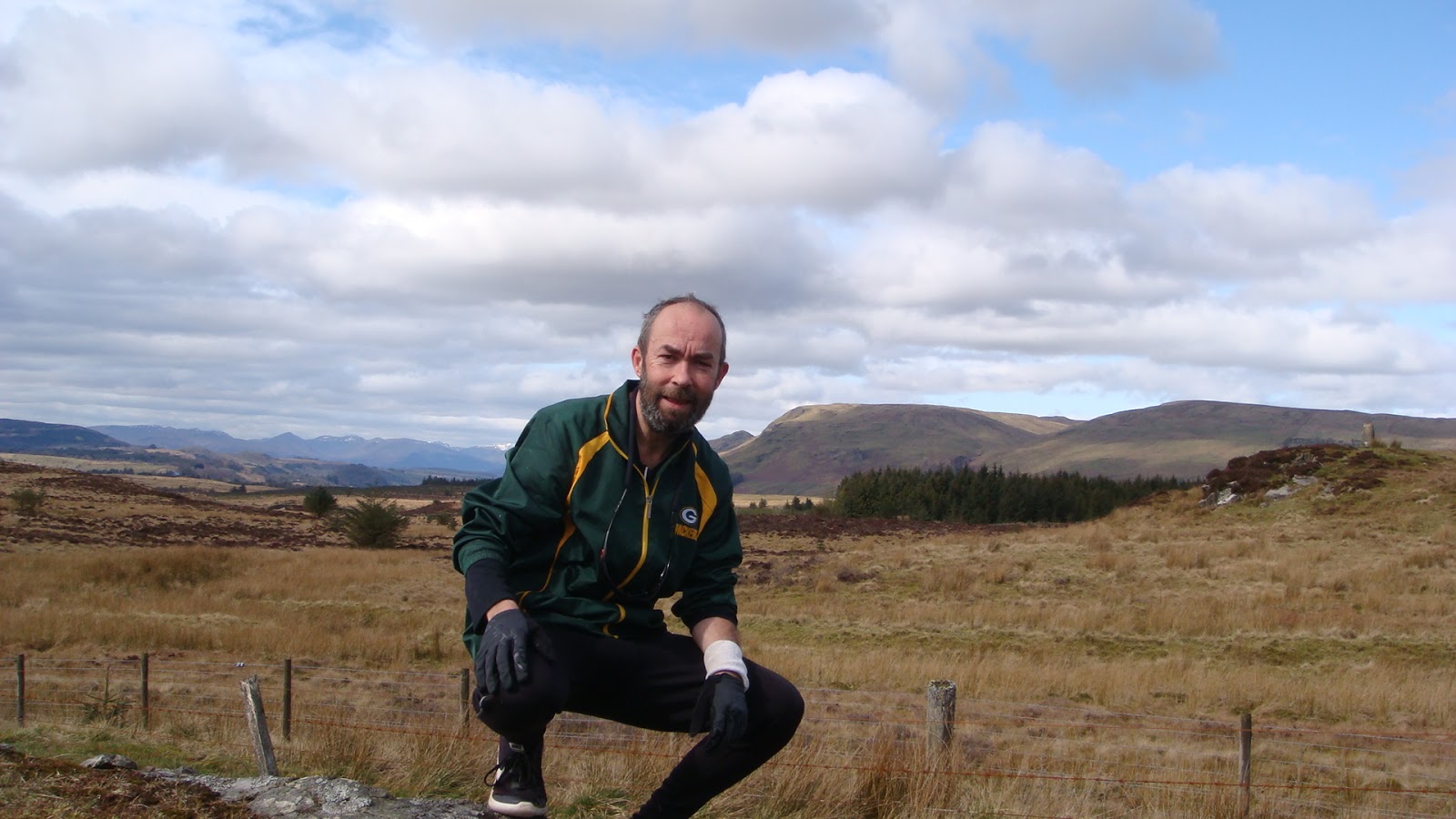
The wild-bearded man atop the plateau of desolation... (Blairskaith trig just behind to the right)

Looking south from Blairskaith into the valley that the city of Glasgow nestles in.

For those of us with dodgy Latin (and/or Monty Python) it means 'Humans, go home'.
Once down from Blairskaith, there's a whole new beauty to be found in these bucolic back-lanes between Blairskaith and Baldernock and Dougalston. See below links for more details.
https://cyclingmeditations.blogspot.com/2018/04/the-odyssey-cadder-blairskaith.html
https://cyclingmeditations.blogspot.com/2013/04/milngavie-loop-via-schoenstatt-lennox.html
https://cyclingmeditations.blogspot.com/2016/09/roots-routes-milngavie-to-cessnock-via.html
The Bald Head as Evolved Valve
What is a bald head (at least for the cyclist) if not a valve through which steam may be released? Is this not then part of the evolution of the cyclist, dispensing with the non-essential (hair) in order to get to the essence of areodynamic perfection and metabolic thermostatic control? Have the bicycle, (bald) cyclist, and earth, (like the wing, bird, and earth), not then become one in their conviviality and intimacy together? Has the bald cyclist in becoming more streamlined and elementally aligned, in his headwinding and allowing the wind to slide over the body, become an earth-being that is still shaped (formed and in-formed) by the elements and the earth? Is the cyclist not then, when compared to the industrialized and the closetted, the carried and the over-clothed, some kind of bird who by way of his attunement with the earth can still regulate his metabolism, migrate under his own steam, and survive in the most lachrymose and inclement of climates?

Subscribe to:
Posts (Atom)