The Sky-Seat at Cuilt Brae


[W]e need community of the soul. Whatever our religion or lack of one, we need spaces where we can take rest, compose and compost our inner stuff, and become more deeply present to the aliveness of life. We need to keep one eye to the ground and the other to the stars. We need to learn that when we let loose our wildness in creativity, it is God-the Goddess - or call it Christ, or Allah or Krishna or the Tao - that pours forth. It does so from within as a never-ending river.        
Alistair McIntosh, Soil and Soul


Every person needs a perch.

And no meditation on Greater Glasgow's elegant and curvaceous body would be complete without a brief rest upon the perch par excellence, the sky-seat at Cuilt Brae. Nestled on the edge of Mugdock escarpment, the views north to the Strathblane Hills are seriously inspiring. Beneath us is the quaint little village of Blanefield nestled in its own little portion of the exquisite Blane Valley.

It's a beautiful cycle up from Glasgow following the Kelvin cycle/walk way up to Maryhill and beyond. Or, equally, jump on the train with the bike and get off at Milingavie. It's only a short cycle from here (maybe 5km) but the first half is all uphill towards Mugdock village before taking the Old Mugdock Road - aka. the helter-skelter - downhill to Cuilt Brae


You could, to make a circular route, follow the West highland Way up by Craigallian Loch and then just before it emerges onto the B821 road (at the top of the map) take the little path that doubles back up into the forest where it connects with Cuilt Brae (top centre of picture overlooking Blanefield). And then take the Old Mugdock Road back up to Mugdock and down to Milingavie.
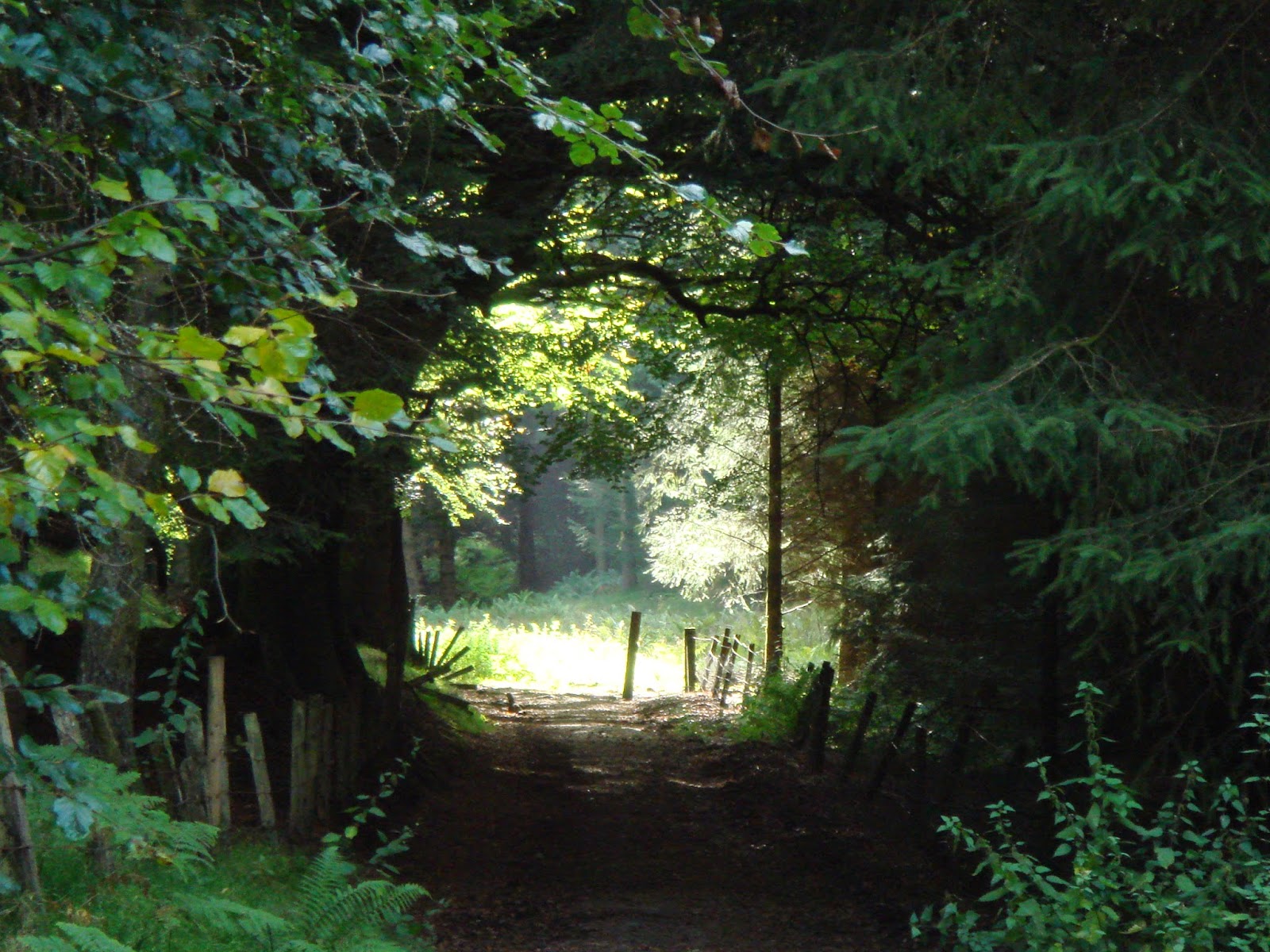


Through the woods of Mugdock.... like travelling through the womb.


The sky-seat(s) at Cuilt Brae, and that mind-opening view....


 'Geo-Joy-ology' : A Geology of Joy.  [The Strathblane Hills from Cuilt Brae]


The Prayer of the Heliotrope


'The Flow-er'


Our failure to see plants as living creatures, and to appreciate ourselves as some kind of sped-up plant, is the result of limited human perception, a sign of the boundaries of our senses or the degree to which we have allowed them to atrophy, or the fact that we have become too speedy to perceive the slower rhythms of other life forms.

The Walling of Awareness, 4 Arguments for the Elimination of Television, Jerry Mander


After abandoning the car some ten years ago (like the television some years before that), I feel as if I have become more plant-like as a result, altogether more epiphytic, and actively drawing sustenance from the larger plant upon which I am growing (as non-parasitically as possible).

This fresh plant-like perspective has enabled a more profound understanding of the subtle movements - the slower rhythms of other life forms - that exist within nature as a whole, and how they interact, cultivate and exploit. 

Two of the most exploitative inventions of the 20th century, the internal combustion engine and the cathode ray tube, have with their indulgence of speed transformed this plant-like perspective to one which is polluted to the extreme. The result being that we become too 'speedy'!

No wonder we live in an increasingly anti-religious society. Speed and 'god' are like chalk and cheese. The ultimate ground of being can only be reached through stillness and contemplation. The question of religion is not pertinent to plants because they are religion. This (!) is what religion is.  Spontaneousness. Absence of artifice. Total loss of self.

Moving under one's own steam (work done in gratitude) might thus be described as some sort of 'prayer' through which the sacramental act of energising one's self is performed; not for any particular purpose other than perhaps to celebrate one's capacity to do so; a spontaneous prayer, absent of artifice, one which, to paraphrase Berry's verse below, illuminates the place where you are as everywhere.


Stay away from anything
that obscures the place it is in. 
There are no unsacred places;
there are only sacred places
and desecrated places.

Wendell Berry


The Loss of the Locomotive


Life is motion.  Wallace Stevens


Today, whilst browsing the shelves of Glasgow University library I came across The Human Brain, A Guided Tour, by the eminent English neuroscientist Susan A. Greenfield.

Opening it purely at random, I came across this, on page thirty-four:

Although plants can move in the sense that they may turn to the light, they cannot generate movements as we do. Outside the realm of science fiction, no plant locomotes from one place to another. In clear contrast, all animals are on the move - that is, they are animated. Interestingly enough, the Latin animus means ‘consciousness’… The importance for moving creatures of having some kind of brain is best illustrated by an observation initially made by the late Emperor Hirohito of Japan, for whom the study of marine life was a passionate hobby. The tunicate in question is known as a sea squirt. When it is an immature larva the sea squirt spends its time swimming around: not only is it capable of coordinated movement but it also has a primitive vibration-sensitive device, crudely comparable with an ear, and a primitive light-sensitive device, roughly analogous to an eye. In fact the sea squirt could be said to have a modest brain. However, when it becomes mature the sea squirt changes its lifestyle and attaches to a rock. It no longer has to swim around anymore, because it now lives by filtering seawater. At this stage the sea squirt actually performs the remarkable act of consuming its own brain.


Dreams of Greenock: Bell's Bridge to Gourock


Listen. Put on morning.
Waken into the falling light...

W.S Graham

It were the gulls that woke me. They always do. In Govan where I live, the gulls are a regular sight (and hearing). With their cries and their flight they bring an aliveness to this area that indubitably marks Govan as an elemental place. After years living here I consider myself fairly fluent in their language. And this morning they told me that the coast was the place to be.

Kaya kaya kaya....ya ya ya ya ya...


The whole route here follows the Sustrans National Cycle Route 75: for the first portion to Paisley see the 'Bell's Bridge to Paisley' entry in this blog. The second part, from Paisley to Gourock, follows the dedicated off-road sustrans route 'Paisley & Clyde Coast Railway Path', and is clearly marked along the way. You can find the pdf map here:

http://www.sustrans.org.uk/sites/default/files/documents/paisley20and20clyde202004.pdf


From Paisley, there are a number of interesting tangents to the route. Just past Elderslie look out for the signpost pointing you towards the Wallace Monument standing in the shadow of an Elder tree. It’s a fine monument decorated with several bronze plaques. Wallace, it is claimed, was born here circa 1270. At the bottom of one of the plaques are the words Bas Agus Buaidh. It is the old Scots warrior cry - Death and Victory!


Further along just after Johnstone, there is a fork in the path, the left of which leads down to Lochwinnoch and Ayr, and the right of which leads to Bridge of Weir, Kilmacolm, Port Glasgow and Greenock. Both are equally splendid routes with a fair bit of history, natural and other.
     
At Bridge of Weir, the path passes over the river Gryffe and continues on to Kilmacolm passing the quaint and anachronistic Quarrier's village, well-worth a detour (it has a dedicated path down to it from the NCR75). Now mostly privately-owned homes, the village still retains an unrelenting sense of another era. Definitely worth a visit.

 Like stepping back a hundred years, Quarrier's Village, Love Street.


A few kilometres on is the bourgeois homestead of Kilmacolm. Charles Rennie McIntosh has a house in there somewhere, on the hillside.

Kilmacolm


From Kilmacolm it's not too far to Port Glasgow and some wonderful views across the estuary to the islands and highlands of the north and west.


Port Glasgow to Greenock is a beautifully tree-covered path giving the impression of cycling through a tunnel of trees. The views north are simply stunning.


Gourock train station is ten minutes down the road through Greenock, and from here the 45 minute train journey back to central is a quiet joy.


Disintegrating Distance, Embodying Space


 Meditate upon space as the highest reality. The Upanishads


The Italian architect and critical theorist Franco La Cecla, after his epiphany on an airplane from New York to San Francisco, appeared to understand the disintegrating capability that covering distance mechanically (and not organically) could have on the self:

The true problem with speed, he writes in Against Architecture, is that today one no longer occupies space in it. One obstacle to narrativity is that space has become discrete: in order to fly from New York to San Francisco one has to ignore everything that is in the middle, that took the pioneers three hundred days or more to cross or eighty days for those who preferred to navigate the way around.


...space has become discrete...

When space becomes unnoticeable, as in the disintegration of distance and the use of mechanical conveyance devices, and time becomes correspondingly so paramount, there is a clear breach in what might be called the quantum continuum. Time has become everything, space nothing.

Conversely, by integrating distance, by covering distance ourselves in the flesh, we thus 'absorb distance' and embody space. We walk it, we cycle it, we dance with it whichever we way can. Space becomes us as we become it. We are tuned in. Timed in. The world passes through us as we pass through it. It should come as no surprise then that this way of moving (or being moved), of negotiating the world - between an enactive self-organising on the one hand and a passive self-being-organised on the other - has a fundamental effect on how we see, and thus correspond with, the world.

In the final analysis, the spontaneous capacity to move oneself through space, to integrate distance and embody space, cannot be underestimated for its power to harmonize man and world.


The Sermon on the Mount


Blessed are the passionate
For they shall be lovemakers in eternity.

[Beatitude, from Love and Revolution, Alistair McIntosh]


I suppose, with a little poetic license, the mount in question could be the saddle of the bicycle... but that may well be another story.


The mount here is the green-grey rock of Dunglass, the inimitable volcanic plug that rests beside Strathblane and opposite the great fissure in the fells at Ballagan. This is the rock that got me sketching, and which continues to inspire me over and over. The view from its summit, a mere 100 odd metres up across the Blane Valley is simply stunning and you don't have to be Edmund Hillary to scale it!


Milngavie Railway station is in the bottom left of the map (it's a 20 minute train ride from Partick, 30 mins. from Glasgow Central). This route can be used with the Milngavie circular map (see earlier post) via Lennox Forest. Dunglass is in the top centre of the map, just to the east of Strathblane. This is a dedicated walk/cycle way, The Thomas Muir Heritage Trail, that runs from opposite Strathblane Parish Church all the way round to Kirkintilloch and then onto the canal towpath down to Bishopbriggs.


Today, Good Friday, I was a little surprised to see what looked like a cross fixed atop it. But not that surprised, as I knew that to the south of Glasgow near Newton Mearns, another mount, that of Duncarnock Craigie, regularly had an Easter Sunday 'conventicle' upon it. These conventicles (or open-air services) are a throwback from a dark period in Scottish history when the Stuart monarchy and Charles II (who believed in the divine right of kings) sought to control the church (who thought primogeniture an aberration of the special relationship between God, the church, and the people) by ousting Presbyterian ministers from their parishes and replacing them with Episcopalian bishops and ministers.These ousted ministers simply took to the hills with their congregations holding their masses al fresco. Troops, however, patrolled these hills and moors (more so to the south of Glasgow than here to the north), and if they found any of these 'illegal' masses, were apt to hand out 'on-the-spot fines', notably summary execution and/or imprisoning them.


And so it was, atop Dunglass this fine April day, that a silent sermon, a beautiful beatitude, was given, in praise of space, in praise of wind, in praise of flowing air and running water, in praise of the birds and the animals...

Midst this silent 'prayer' ('work done in gratitude, kindly and well, is prayer,' wrote the 'hillside farmer' Wendell Berry) it was then that I realised what the cross and the crucifixion meant. 

The cross represented the work on the Self; the work itself (unremunerated, unrecognized - 'this is not work for hire' writes Berry) was the sacrifice....

Whether you call 'it' God, the Tao, or the Force (it really doesn't matter), up here, gazing across the resplendent Blane Valley and that great monument to deep time, the Campsie mesa, all space and time melts away, as does consciousness itself (the air and the exertion will do that to you), to leave you thoroughly immersed in all that is. Like this, 'thinking the unthinkable', one thus becomes as God, or perhaps more accurately, in God, (or as I prefer to say, in Love), as one becomes One.

'Love is the delicate but total acknowledgement of all that is', the writer Doris Lessing once remarked. 

Blessed are the open-minded, for they shall inhabit Love....


Looking north-west over Strathblane village, through the cleft between the Campsie Fells (on the right) and the Kilpatrick Hills (on the left), towards the Highlands. Like something out of a Caspar David Friedrich painting, only more beautiful...


Looking east towards Lennox Forest (on the right) and the great Campsie mesa above Lennoxtown on the left. The Thomas Muir Trail can clearly be seen just below Dunglass (running parallel to the road further to the left.


A Brave Face for the Braeface: Le Petit Boucle & The Small Croy Circular


 Follow the pink road down from Croy to Auchinstarry, then the blue towpath to Banknock and onwards..


Ok, we're back...

After 5 months in Saudi Arabia (one has to journey through hell in order to reach paradise!), and another beautiful bodyswerve from a dreich Scottish winter, I'm back on the path (preferably car-free & thus carefree) with Fatty (the cannondale).

As usual, the Kilpatrick Hills, the Campsie Fells and the Renfrewshire Moors (and the roads, paths and lanes in and around them) all take centre stage, even if they do lie on the circumference. Last Easter weekend was a beauty weather-wise: sunny, dry, with a lovely cool breeze - and so I nipped into the hills (why wouldn't you?).

I had discovered a new road into the Campsies alongside Banknock (a stranger on the road had told me of it) and so that morning I jumped a train at Queens Street which, 12 minutes later, deposited me onto the platform at Croy. From there, I headed down to Auchinstarry where I joined the canal towpath eastwards towards Banknock.

 Glenskirlie Castle on the road to Banknock (just after leaving the canal towpath)


 Braeface Road into the fells


This is a more gentle entrance into the fells than say the Tak Ma Doon or the Crow Road which I had previously taken. The road sweeps gently upwards past a little hamlet called Braeface towards Drumbowie Reservoir. Here, there are a few options which you can see from the map. I chose the shorter route which just before the wee stone bridge at Glenhead happily coincided with a lovely spot to sit and open my flask of coffee. Another bench of serenity on the road to nowhere in particular....


Further on, the hillfort of Myot Hill, now studded with transmitters, clearly states its case in your field of vision. Soon, the road comes to Broadside farm where due to a slight optical illusion and the way the farm is placed it's easy to take a wrong turn, so check the map to make sure you're going the right way!


This should take us out onto the B818 which will swing round to the crossroads at the Carron Bridge Hotel. Again, as with all crossroads, there is a choice: north to Stirling (8miles) and get the train back, continue west along the B818 to Fintry and head up and over Campsie Glen (and get the train back from Lenzie) or turnleft and head south onto the Tak Ma Doon for the best downhill slalom you'll ever have on a bicycle that doesn't involve drugs! But be careful!!! Some of those bends are rather tight, and if you overshoot, it could well be game over very quickly. Just enjoy the 'soar' and take it easy, make sure your brakes work and enjoy the rush of wind as you plough through the air and space.


At the top of the Tak Ma Doon looking south, with Tinto Hill just visible on the horizon - Check your brakes!!

At the bottom, ejected into Kilsyth, it's easy enough to get back to Croy (via refreshments at Auchinstarry Canal) and a well-deserved twelve minute rest before being papped out onto the parvis at Queen Street.

Enjoy. And above all, let it, this small Croy circular, en-joy you!