Lassooing the Horizon: Thorntonhall to Whitelee Windfarm


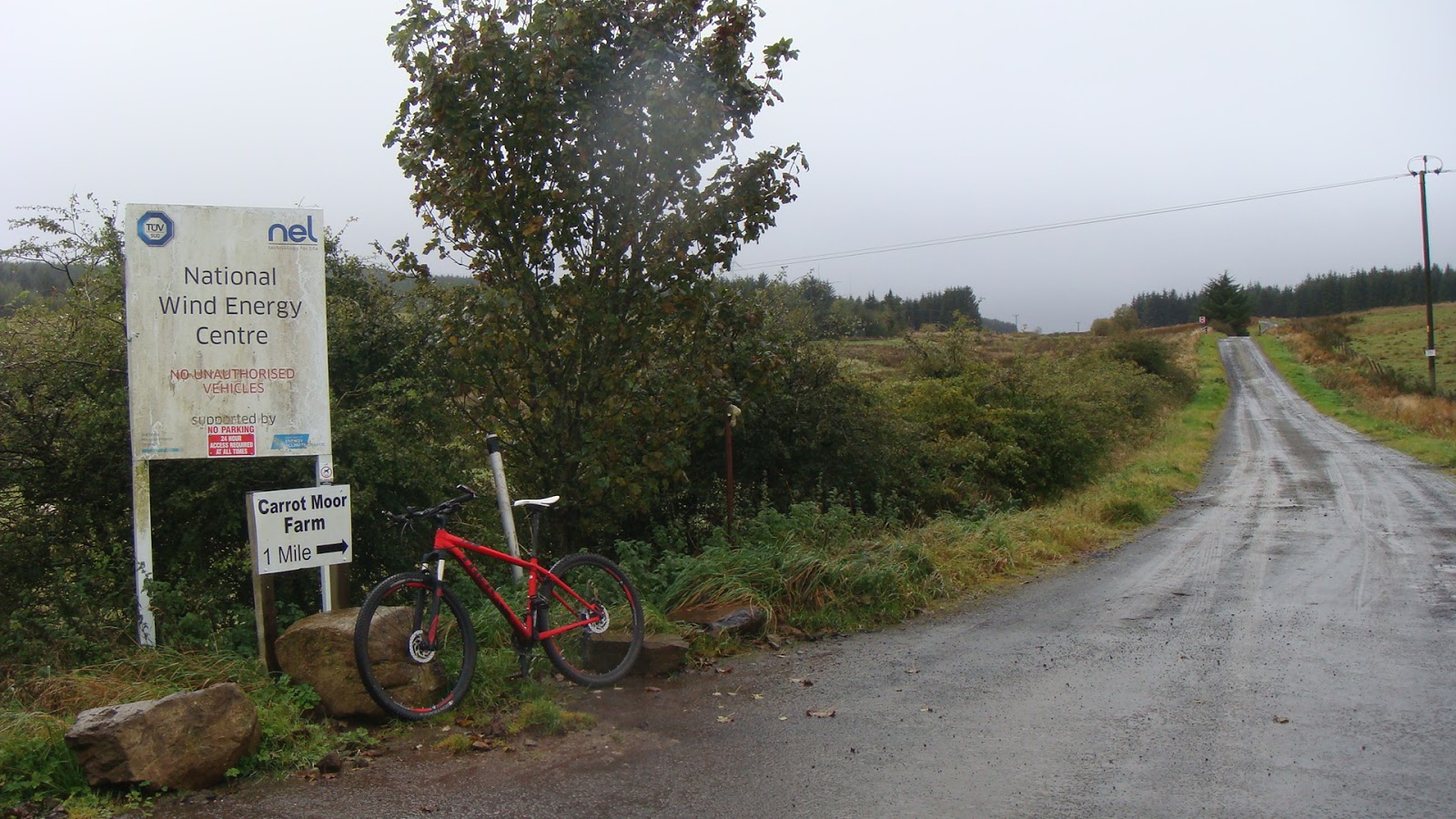
Finally, after years thinking about it, I got to Myres Hill within Whitelee Windfarm. I don't know why I had avoided it until now, because it is quite easy to get to, especially if you catapult yourself with the train up to Thorntonhall. In the map opposite, it's the turquoise lassoo coming up from Thorntonhall, and the turquoise line threading back down through the city to Cessnock. (I trained it from Pollokshaws West to Thorntonhall). Once past Eaglesham, the space begins. After Carrot Farm, I saw no-one until Whiteless Visitor Centre some several miles away. It is desolate up here, but this sort of desolation inspires me. Granted, the felled trees make some of this place look like a mass grave (it's mostly Forestry Commission plantation), as does the sinister sound from those turbines, but the space itself is worth it. And on a clear day, the views too.


The veiled horizon just out of Thorntonhall station approaching Eaglesham.


Carry straight through Eaglesham on the way there. On the way back you will emerge (hopefully) from Polnoon Avenue just there on the right after the pelican crossing.


Straight on here. Do not go left or you'll end up in Strathaven!


Take the right fork here towards Carrot Farm. 


Bleak.... but somehow beautiful.


From Myres Hill, looking down on a sliver of the city. From just below Myres Hill there are a few houses which have put signs up saying no through road (through their little plot). This is another example of residents not offering an alternative right of way whilst blocking up an existing one. This is not only illegal, but silly. Ignore the signs of dogs and the like and stroll through their little patch (it's only a couple of hundred metres). If anyone says anything about it being 'private land' remind them of the Scottish Outdoor Access Code, suggest that they read it online or download a copy. They have a responsibility to know the law of the land, and to behave accordingly. I mentioned this to the girl at the Whitelee Visitor Centre and she told me the residents have been spoken to about this. So there's no excuse.  Anyway, chances are you won't see anyone about.


Wind power!


It is a bit of labyrinth so take care not to get lost. The latest OS map has all the access roads and turbines marked and there is another map you can get from the Visitor Centre and which I have included here as a PDF link. The turbine numbers are marked and you can use them to guide you.


Looking north over Loch Goin.


Dunwan Hill from the back...


The road back down from Whitelee Visitor Centre is great! It has a dedicated cycle lane and is all downhill, all the way back down to the city. This is just approaching Eaglesham.


Green Cycling

In Scotland, true golf courses are not created, they are born out of the land.

I often cycle through golf courses whilst out and about. Most of them adhere to the right of way that we Scots have over our lands, and provide paths for walkers and cyclists alike. Naturally, if anyone's about I will observe golf etiquette and dismount, but I've never had any problems with golfers. In fact, they are often a good source of local knowledge, whether it be the weather or the land and its resident flora and fauna.


Around the Glasgow strath there are several golf courses with astonishing aspects of the valley. Indeed, when I was up at Kirkhill the other day admiring the vast vistas, I thought about my botanist friend's scathing remarks about there being too many golf courses in Scotland. Whilst I understand his sentiment, I also see that golf courses have protected the land from further development. To be sure, golf courses are hardly wild spaces but they do harbour a sense of wildness especially when there are no golfers about to distract you. Furthermore, they tend to be outside of the noise of the city and thus accommodate a certain pastoral quality. And because Glasgow is a valley, many of these course are on its slopes, thus offering views of the valley like no other. Then, there is the flora and fauna. And though some greenkeepers chemically spray their greens and fairways, there are some, like Eastwood, Kilmacolm and Pollok who go sparingly with such toxic substances. Correspondingly, foraging for mushrooms on such courses is a joy to behold. Then, there are the trees, huge sessile oaks, Norwegian maple, ancient stands of hazel and hornbeam... What giants there are among us, and yet most of us only see a  little white ball. Then, there are the birds, the insects, the whole biotic community other than the golfers themselves... the list goes on and on, just proving the paradox: that golf courses are least of all about golf.

I have thus concluded that golf courses are a good thing, because let's face it, it's open green space, often wooded parkland.... which breathes not just by itself, but breathes into you. Often when coming back from the hills behind Neilston, I cycle through a green corridor of golf courses to my home in Cessnock (virtually the centre of the city). From Kennishead, I pass through Cowglen Golf Course, Pollok Golf Course and then Haggs Castle Golf Course (the last two within the spacious confines of Pollok Country Park). I feel like a vole or a rat creeping through the undergrowth, avoiding all traffic en route, back to my burrow. It's a marvellous thing when you re-engage your animal drive!


Out of bounds for golfers, but not for intrepid human beings. The wooded slopes of Dalmuir Municipal Golf Course.


Ten minutes from Barrhead train station, and emphatically all uphill, Fereneze Golf Course with its airy views over the strath.


Gourock Golf Club!


The 16th green at Windyhill Golf Club in the Kilpatrick Hills looking south...


 The Road Hole, Dalmuir. (13th)


Cowglen (8th)


Langbank (17th)


 Dalmuir, 2nd.


Pollok


Haggs

Knightswood

Paisley

Kilsyth

Ralston

Eastwood

Bonnyton

Kilmacolm

Lethamhill

Balmore

Dougalston

Routes with Roots: The Joy of Valley-Cycling


Deep in their roots, all flowers keep the light.

Theodore Roethke


The route system of any life-form is vital to that life-form's vitality: How it goes through its environment, where it goes in that environment, what nutrition and insight it picks up along the way...

Routes, like roots, provide anchorage to the plant by fixing it into the soil, by locating it in space and time. And the soil, if you didn't know this by now, is the soul, the only difference being the small matter of changing an 'i' for a 'u'.

All plants (like cyclists) have a primary root from which lateral roots develop. I recall as a cyclist many years ago having no roots at all, really. I rarely left the confines of the city, the bicycle simply being a means to an end, that end being getting to where I was going without forking out cash I did not have for the bus or train. My primary root back then was a jogging route, but it didn't really fix me in place being as it was very small, too localised, and too confined.

Then, I discovered valley-cycling, and the beauty of cycling out of the city, into the hills, doon the watter, up into the lochs and highlands. And that's when those roots started growing and that anchorage to the land, to the stage now, some ten years later, where I feel truly rooted in the Glasgow strath. To the point now where 'I know my way around'.

Routes here, of course, are all about your locomotive force, your ability to carry yourself across and through the land, without polluting it; in short, to know your territory and your home range. The human is precisely human because of this territorial knowing, because of his rooting in the very contours of the earth itself. The 'soiling' of the self is essential for the human to breathe clearly. As is his locomotive and cardiovascular force. By this, I do not mean tearing the land up with your mountain bike as some people are apt to do, or treating the land like some sort of theme park for you to exploit, but using the bicycle sensitively as a form of expansion which can re-humanize you through its ability to expand your local range. The equation is simple: the more one comes into (semi-) wild places, alone and awake, the more one comes into one's Self, and the more one be-comes Nature ('becoming' simply meaning 'coming to' as an attentive and wakeful arriving).

If you think about it, what is a root (route) if not pure locomotion anchoring the organism within the greater matrix that enables it? The root though it may nourish a particular organism, is always on the move towards the universal.

Locomotion is the basis for cognition too. If you don't move under your own steam, then it follows that you're gong to have problems thinking too. Synapses and dendrites are their own kind of roots.

This is the great scam of the modern automobile that is neither auto nor mobile: it doesn't just dislocate you from place via the destruction of your anchor and the usurping of your vital force by a machine that carries and pollutes you, but it removes you from your own cognitive force, and your ability to think your way through the land, and thus yourself. In other words, machines like this turn the 'hu-man' into 'man' by divesting him of his intimate and dare I say it 'loving' connection with the soil (humus). This is the world we now live in - 'world' from the High Germanic wer + alt, meaning the age of man). Personally, I prefer Godard's definition as voiced by Jean-Paul Belmondo in Pierrot Le Fou: L'age du cul. Yet, it is not world we ought to be inhabiting, but Earth, and by extension, Cosmos. Once again, we are blind-sided by the stupor that is man and his self-polluting inventions.

It is this removal from your routes (and roots) that the technological society (as the decadence of being carried and prammed) is most guilty of. There is no more serious crime than the severing of a plant's roots so that 'nutrition' from an outside source can be delivered to it.

The result of this existential mutilation is the ghost in the machine, the absurd idea that the mental and the physical are not connected, or at least not intimately together. Man has removed his self from his greater body not knowing that to do so is to disembody himself. The ghost - the spectre of man - is the disembodied entity who has allowed his existential feelers to be amputated, his locomotive force to be cut off and replaced with an all-polluting one. The machine is the world - the age of man - that has decided that being prammed across the land is far better than negotiating it yourself, that pollution is better than health, that the particular and the particulate is better than the universal, that the global is better than the local...

Driving itself, or any kind of mechanical transportation that pollutes the environment, is a form of violence. One might argue that science itself has permitted this violence by separating the object from the subject, the perceived from the perceiver. One no longer sees the  land as intrinsically connected to one's existential self but tenuously linked to one's ego self. Driving itself is proof of this. Yet this violence is also perpetrated against the driver via the hijacking of his locomotive force. Man is no longer mobile, he is emphatically seated and belted in when driving. His consciousness is hijacked too. Speed infects his perspective. The violence emerges as a disease. A dis-ease with natural forces, with the simple and frugal, with the local: with getting from A to B under your own steam.... by your self.

We now live in the cake-eating age in the West, where people want to have their cake and eat it. It's a real problem. The cake however is only so big and most of it is gone now. Just a few crumbs left round the edges...

The sooner we all start baking our own cakes the better....Get that steam going...!


A Cyclist's Heart

Recently, upon looking into the anatomy of flight, I discovered some interesting facts:


1. A bird's heart is on average 40% larger than the heart of a mammal. This is because flight requires incredible circulation.

2. Flight burns up enormous amounts of energy. Birds consequently have very efficient digestive systems. To stay as light as possible, they don't have the luxury of storing energy. Only during migration do birds begin to stock up.


And then, I thought, why not substitute 'bird' for 'cyclist' and 'flight' for 'cycling'? After all, and as I've intimated elsewhere on this blog, cycling is a form of flying.


1. A cyclist's heart is on average 40% larger than the heart of a non-cyclist. This is because cycling requires incredible circulation. (And also because he has not closed himself off to his environment, sharing a fundamental and vital solidarity with all living breathing creatures).


2. Cycling burns up enormous amounts of energy. Cyclists consequently have very efficient digestive systems. To stay as light as possible, they don't have the luxury of storing energy. Only during migration do cyclists begin to stock up.


Much better, no..?


The Way of Air & The Receiving of the Rain

Under the tutelage of Nature, the aimless saunterer (or cyclist) learns (or recollects) the art of receptivity, of opening his soul to the immesaurable density of reality. 

Daniel Conway, Answering the Call of the Wild


The old German cobbler Jakob Bohme once wrote in his obscure treatise on God that one needs to pass through hell in order to appreciate heaven...

The dialectic of paradise is such that one needs to have tasted hell in order to know the taste of heaven. And it is here, that taste, in the air around us, in that freshness that blows into our nostrils and through our whole bodies.

Glasgow is an airy place no doubt, but not all places have that vitality of breathing. When I lived on the Mazovian lowland in Warsaw, an area known for its flatness and lack of undulations, there was a distinct windlessness that entered the proceedings. The flow of fresh air just wasn't there as it is here in the Glasgow shires. The topography and the hemmed in-ness of Warsaw meant that wind was something of a luxury. Summers could get awfully muggy and close, and there were times, in spite of the lovely warmth and sunshine, when I prayed for a cool breeze.

Living in countries like Saudi Arabia, Qatar, and Libya, I have realized that fundamental dialectic of heaven and hell. I can now see greater Glasgow, with its gentle hills and moorland, its proximity to the highlands and the islands, its gentle rains and winds, its shifting light and cloudcover, as that heaven. Who wouldn't, having felt the pain of fifty degree sunlight burn your skin? Or the suffocating humidity of a Jizani soiree in south-western Saudi Arabia? There are life-giving properties here that you just do not have in certain locales around the world. The west of Scotland where I live and breathe is particularly endowed with these qualities.

Yet one must learn to receive the rain, to welcome the wind.... and to understand it. And the best way to under-stand anything is to stand under it. To feel it. To develop a relationship with it as one might with another human being. These elements are your relatives before any of your own kind; they allowed you and your human relatives to emerge. These elements, then, are your greater relatives that precede all others.

However, we are been covered up and coated over with all manner of fashions, so as to prevent this tuning in to the weather. It's probably why our delusions regarding global warming are still prevalent: we cannot feel the weather anymore. Our lives are too air-conditioned. Our brains too washed with over-chemicalized shampoo.

It's the difference between being awake and being alseep - between synergetic Being and soporific Being. All these wind and rain proof tops surely bode no good for the oneness of organism and environment. I am the rain, a wise creature once croaked. And I am. For without it I would not exist.

Our psyche, after all, is a function of the air that blows through us, that feeds and nourishes us. This is the word that is used to translate the Hebrew word nephesh from the Creation story in Genesis 2.7:

And the Lord God formed man of the dust of the ground, and breathed into his nostrils the breath of life; and man became a living soul.

The soul emerges out of the air and the rain and our interdependence on them. Indeed, soul may well be this deep reality that nothing can exist without everything else. That I am both that nothing and that everything else. That to confuse this closed bodily form (or this fine-tuned ego) with I is to make a grave mistake and launch oneself onto the path of a slow self-destructuring where one ineluctably becomes a dislocated fragment, an inauthentic mask imposed upon a faceless origin.


Broadband of the Bodymind


You can learn a lot from a computer, from its make-up, its workings, and how it's put together. The bodymind is a lot like a central processing unit for instance, except far more complex than any computer man could make. It has bandwidth, it has the capability of speed, of quickness and sharpness, and it can be infected with all manner of viruses that can slow it down and if not attended to eventually kill it. Yet, the bodymind is not a computer in the traditional sense, to think so is to lead yourself down a dangerous path; it is far more than that.

Broadbanding the mind is the key to understanding how much more the Mind is, and the best way, in my humble opinion, to do this is to 'space out', and literally free up space in (de-fragment) the Mind. Most people these days have a very narrow bandwith to their Mind, very little head-space to fly about in and contemplate. This is due to our over-reliance on analysis and calculations, planning and operational thinking, effectively un-presencing ourselves by focussing on the future. This metaphysical removal of ourselves from ourselves leads to 'action', and all action is karma. When we are fully immersed in the present, when our mind is disinfected from the future, our bandwith like our Being becomes broad and sharp.

But what, I hear you ask, is the best way to space out. Lots of youngsters immediately think drugs: ecstasy, after all, is offering you that ecstatic experience, to step outside of this manufactured ego-driven self and become your (real and true) self, and to a large extent it succeeds, but the problem with chemicals and psychotropic substances like ecstasy is that they necessarily affect your system in other ways, that the ecstatic experience you have garnered is predicated upon an equally un-ecstatic experience which drug takers will no doubt identify with the working week that follows the weekend, a week-long comedown. When, however, you glean that ecstasy not from some muppet in a jester's hat in a darkened discotheque but from the earth herself, there is no comedown. The ecstasy lives within you, albeit at times on a lower frequency. It accompanies life and enriches it, whether that life be your own, or other lifeforms that you encounter along the way. The ecstasy is, you realise, within you. You don't need a pill to unlock it; all you need is a little discipline, a vague outline of the way ahead, a pair of legs, and some gently rolling hills with plenty of space. 

The shape of space shapes!

For someone living in Glasgow then, a valley-city surrounded by bucolic shires and slow undulating hills, the ecstatic experience is never far away. 

The other day, upon watching a snippet of a television program, a youngster was heard saying that she thought 'hiking was pointless'. These are the same youngsters that seem permanently connected to their techno-prosthetics, and who have been weaned on a thousand flashing lights and noises. Of course, something like walking in a forest  or on a hillside (for someone who has never even been introduced to one) would appear to the most boring thing imaginable. Yet, it is not the hillside or the forest that has become boring.... but one's brain and Mind. To call walking in wilderness pointless reveals the extent to which mankind has been removed from his own deeper self, that primal savage for whom walking in wilderness was a matter of survival and vitality. Now, we exist not in spheres of aliveness and organicity, but in boxes of concrete and polysterene. The whole 'pointlessness' of hiking is the point! Within that unoperational thinking, space appears, bandwith expands. And the bodymind reaches out to take hold of itself...


Body-Washing: Brainwashing via the Body

At no point before in what we call civilization and the first world has our collective health been in such turmoil. Many of the foodstuffs imparted to us via large corporations should have government health warnings in the same vein as cigarette warnings. Indeed, heart disease is now the biggest killer, not due to smoking or lack of exercise, but due to the shit we eat. And it is shit. I often think (and this is not America!) when gazing at some of the labels and contents (most of which are cleverly concealed) of ready made meals and the like that they should be illegal, or at the very least their producers should be closed down and prevented from ever touching food (and food labels) again. All manner of dodgy tactics are used by these corporations to sell you this stuff, tactics that reveal an ethical and moral vacuum in their CEOs. Nowadays, it's like walking through a minefield trying to find that piece of fruit that has not been sprayed and infected with all manner of chemicals, or trying to find a loaf of bread that is really brown and not just brown on the outside! It's appalling what people will do to each other in order to have that fourth Rolls Royce, or that third holiday home on the Algarve... Greed is now a virtue in our over-whacked society, and if you do not aspire to be rich (in the poorest sense possible, that is, financially) then clearly there is something not quite right about you. Our economy seems to positively encourage the tricking of the consumer, whether it be through downsizing products without telling you, or telling you that it's fat-free when clearly it ain't. I'm all for personal responsibility and eating and drinking responsibly, but that door swings both ways, and if our producers and corporations themselves are not responsible, then what hope is there?

We are being slowly and horribly brainwashed via these over-chemicalised and over-worked foodstuffs. Food affects the brain like no other, and if you spend your days eating nonsense, then your brain will spout an equal amount of this nonsense. Never trust a fat philosopher, goes the old maxim.

So, buyer beware... no take-aways, no ready meals, no kebabs dripping with all that lovely fat...

and go easy on the wine....

and of course always remember the Upanishads:

First, know food...
By food all things live
Towards food all things move
Into food all things return....